Scott Walker is doing a great job in Wisconsin. Unfortunately, the left doesn't see it that way. They want to recall Walker in the worst way (literally). But his reforms are working! Consider this article from USA Today:
"Column: Why U.S. should cheer for Scott Walker" by Nick Schulz
http://www.usatoday.com/news/opinion/forum/story/2012-01-05/scott-walker-wisconsin-unions-election-2012-recall/52394768/1
"The Milwaukee Journal Sentinel, which opposed Walker's collective bargaining reforms, recently noted, 'The governor did balance the budget … he did reduce the structural deficit significantly; he did put a lid on property tax increases; he did give schools and municipalities more control over their budgets than they've had in years.'"
"Milwaukee Mayor Tom Barrett was Walker's opponent in the 2010 election and later attacked his proposals to reform collective bargaining. But with the reforms on the books, Barrett used some of the bill's provisions to help reduce the city's health care bill, saying that the alternative was to cut 300 to 400 city jobs." Yes, the man who opposed Walker is taking advantage of Walker's reforms!
"Interestingly, many labor-friendly figures have long understood that collective bargaining rights for public employees are illegitimate. 'All Government employees should realize that the process of collective bargaining, as usually understood, cannot be transplanted into the public service,' a pro-labor Franklin D. Roosevelt said in 1937. 'It has its distinct and insurmountable limitations when applied to public personnel management.'"
"As political scientist Daniel DiSalvo notes [click the link, it's really good!] in a recent issue of National Affairs, 'public-sector unions have significant advantages over traditional unions. For one thing, using the political process, they can exert far greater influence over their members' employers — that is, government — than private-sector unions can. Through their extensive political activity, these government-workers' unions help elect the very politicians who will act as "management" in their contract negotiations — in effect handpicking those who will sit across the bargaining table from them … Such power led Victor Gotbaum, the leader of District Council 37 of the AFSCME in New York City, to brag in 1975: "We have the ability, in a sense, to elect our own boss."'"
"Collective bargaining reform is also needed to enable genuine education reform. The collective bargaining privilege gives teacher unions political power that is used to block reform efforts and shield K-12 education from entrepreneurial disruptions that threaten established ways of doing things."
"In a recent discussion, Walker told me that 'collective bargaining in the public sector is not a right; it's an expensive entitlement.'"
I'm writing this blog post prior to the January 17th deadline for recall petition signatures to be submitted. I know full well that they will get (have already gotten) enough signatures. Whether those signatures are legitimate is another (long) story. But the point is, they will do anything, legal or not, to get the signatures. Here's one example. This was posted on the Democratic Party of Wisconsin website.
"Cemetery Petition Drive (Recall Petition Signing)"
http://content.clearchannel.com/cc-common/mlib/3627/11/3627_1321474714.jpg
Now why would they meet at a cemetery, hmm? Let the lawsuits begin.
Tuesday, January 24, 2012
Monday, January 23, 2012
Shane Battier - Beyond Statistics
Here is a fascinating look at what it takes to win in the NBA, the stuff that gets missed if all you look at is statistics.
From the New York Times:
"The No-Stats All-Star" by Michael Lewis
http://www.nytimes.com/2009/02/15/magazine/15Battier-t.html?pagewanted=1&adxnnlx=1325530815-CEymaHxj%20FynsvNmfoc25A
"His greatness is not marked in box scores or at slam-dunk contests, but on the court Shane Battier makes his team better, often much better, and his opponents worse, often much worse."
FWIW, this the player that I strive to be when I play hockey. I'm happy to do the little stuff, to cover the other teams best players, and to make the passes nobody notices--as long as we win.
Sunday, January 22, 2012
Ron Paul
Here is another Ron Paul video. You know who I'm supporting this year (and every year). Watch this video and see if you don't change your mind.
Ron Paul - 30% of people who watch this whole video change their vote" posted by civildisorder44
http://www.youtube.com/watch?v=K_RFt0SVilU&list=PL3BD4EED4D0B02775&index=5&feature=plpp_video
I think that Ron Paul is the only candidate who truly believes in governing in accordance with our Constitution, Democrat or Republican. I happen to think that is important.
And just for fun, wouldn't it be cool if more athletes did this?
"Peyton Hillis: 'I support Ron Paul. He represents the constitution.'" posted by bxtidre7
http://www.youtube.com/watch?v=AURgsNCl38U
Friday, January 20, 2012
"Conservatives" don't understand Ron Paul
Okay, I thought I was done with Ron Paul for a while (I do have more material--there's always more!). But I was wrong. I'm hearing too much crap from people I would normally expect to know better. I need to get something off my chest.
I've heard this question, or variations of it, too many times now, usually from blowhards on the right. The basic assumption is that Ron Paul is great on domestic and fiscal issues, but he is some kind of nutjob on foreign policy and therefore not qualified to be president.
Tangent: Yes, I realize that Ron Paul has little chance of becoming president. I think he realizes that, too, which is why I don't think he will mount a third party run for the presidency. At this point he is building a movement, carving out a niche for libertarian and fiscally conservative views within the Republican Party. Leaving the Party at this point would undermine all the progress he has made (and perhaps hurt his son's future prospects within the Party).
Back to my point. It seems like people wish they could chop Ron Paul in half and retain only his fiscal policy positions, discarding his foreign policy. The question is often phrased like this: How well would a candidate do with Ron Paul's economic positions but with mainstream Republican foreign policy positions? Essentially get only the "good" part of Paul.
People who ask this question, or variations of it, betray a fundamental lack of understanding of Ron Paul. They miss the whole point. They don't realize that you can't separate Paul's economic policy positions from his foreign policy positions. The two positions are flip sides of the same coin. The welfare state and the warfare state, inseparable. Any candidate with "mainstream" foreign policy cannot be strong on fiscal policy because such a candidate doesn't truly believe in limited government.
Any state large enough to police the world will also waste money at home and abuse civil liberties. Even if one man could do the former and resist the temptation to do the latter, what about the next guy? And the next?
Turn the question around to see how absurd it is. Can someone who wants military bases around the world, who wants to intervene in conflicts everywhere (regardless of U.S. strategic interests) ever cut the size of government? The big government conservatives (the Republican Party as a whole) are taking the government to the same place the big government liberals (Democarats) are. Different route, same bankrupt destination.
So what do we do? Let ourselves be attacked? Of course not. But we can't police the world. There has to be a lower level of military spending that is consistent with the Constitution yet large enough to protect us. I happen to think that this level would result in a significantly smaller military than we have now, with fewer deployments around the world.
Why Ron Paul Matters
Why do I support Ron Paul? This column gives a good summary. From the Wall Street Journal:
"Why Ron Paul Matters: by Edward H. Crane
http://online.wsj.com/article/SB10001424052970204632204577129132189244456.html?mod=djemEditorialPage_t
The tagline for the article sums it up perfectly: "Among all the GOP presidential candidates, he's the only one who stands for constitutionally limited government."
That's right, for all their hot air, blowhards like Gingrich, Santorum, and Romney have no concept of what limited government even is. I would add that this is not just true for Republican candidates, of course. the Democrats are even worse. But in the end Republicans are almost as bad. They don't realize that if they support a large federal government for their purposes, it will just as easily be used for illegitimate left wing purposes when the Democrats are in power. Only Ron Paul understands this.
Back to the article.
"Mr. Paul would cut the federal budget by $1 trillion immediately. He can't do it, of course, but voters sense he really wants to. As Milton Friedman once explained, the true tax on the American people is the level of spending—the resources taken from the private sector and employed in the public sector. Whether financed from direct taxation, inflation or borrowing, spending is the burden."
"Mr. Paul has tapped into a stirring recognition by limited-government Republicans and independents that an overreaching military presence around the world is inconsistent with small, constitutional government at home."
"...our current [military] expenditures equal what the rest of the world spends, which makes little sense. It is futile to try to be the world's policeman—to try to create an American Empire as so many neoconservatives promote. And we can't afford it."
"Mr. Paul's huge support among young people is due in large part to his fierce commitment to protecting the individual liberties guaranteed us in the Constitution."
Here's one of the hot items at the moment: "...the Stop Online Piracy Act moving through the House is a clear effort by the federal government to censor the Internet. Mr. Paul stands up against all this, which should and does engender support from limited government advocates in the GOP."
I totally agree with this: "Austrian economics. Mr. Paul is often criticized for references to what some consider obscure economists of the so-called Austrian School. People should read them before criticizing. Nobel laureate Friedrich von Hayek and his mentor Ludwig von Mises were two of the greatest economists and social scientists ever to live." Amen.
"Mr. Paul, like Austrian School economists, understands that we would be better off with a gold standard, competing currencies or a monetary rule than with the arbitrary and discretionary powers of our out-of-control Federal Reserve."
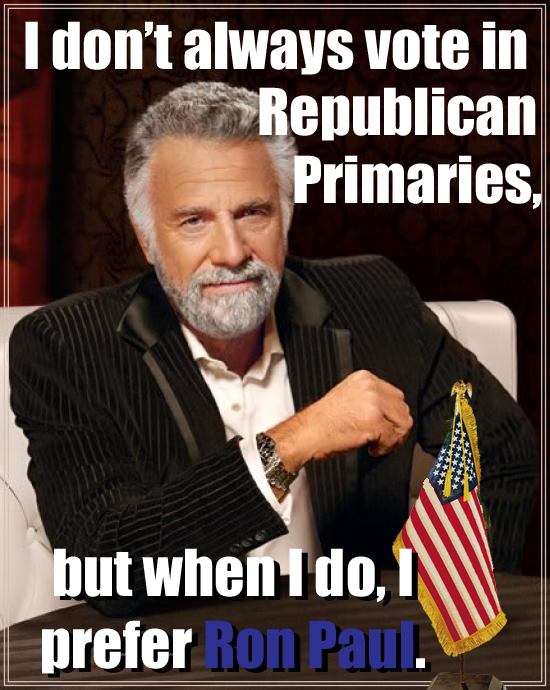
And just for fun, here's a cool meme:
Thursday, January 19, 2012
The Best Google Logos Of 2011
I haven't taken a look at many "best of the year" lists this past year (unlike last year when I did a fair amount of surfing). But I did see a couple I did like and had to pass them along. First, from Marketing Land:
"The Best Google Logos Of 2011" by Danny Sullivan
http://marketingland.com/googles-happy-new-year-logo-recapping-the-years-special-doodles-2367
Next, from Mashable:
"30 Best Google Doodles of 2011" by Christine Erickson
http://mashable.com/2012/01/01/google-doodles-of-2011/
I loved seeing these Google Doodles when they came out during the year and it was fun to take another look at them.
Wednesday, January 18, 2012
Some recognition that subsidies are a waste
Never saw this coming. Even the notoriously liberal Washington Post appears to be recognizing the folly of government intervention. I won't hold my breath and expect them to think rationally in the future, but it's a start.
"Overcharged" by the Editorial Board
http://www.washingtonpost.com/opinions/overcharged/2011/12/30/gIQAzQ0yUP_story.html
I am happy to see that ethanol subsidies and subsidies for installing a 220 V electric car charging stations are now history. In a sign of growth, the Washington Post finally recognizes the ethanol subsidies (for internal subsidies on domestic ethanol and tariffs on imported ethanol) as "two of the most wasteful subsidies ever to clutter the Internal Revenue Code..."
Check out this interesting wording from the Post: "Evidence is mounting that President Obama was overly optimistic to pledge that there would be 1 million EVs on the road by 2015. Electric cars are not likely to form a significant part of the solution to America’s dependence on foreign oil, or to global warming, in the near future. They simply pose too many issues of price and practicality to attract a large segment of the car-buying public. More prosaic fuel-economy innovations such as conventional hybrids, clean-diesel cars and advanced gasoline engines all show much more promise than electrics."
That's the nice thing about having a brain, I don't have to wait for the Post to tell me this stuff. I can figure it out for myself.
I wish people would realize that it's not just ethanol or electric car subsidies are wasteful. Government shouldn't be getting involved in picking winners and losers in the market. They just make things worse.
Subscribe to:
Posts (Atom)